
Popular Articles and Interviews
CBC Ideas.
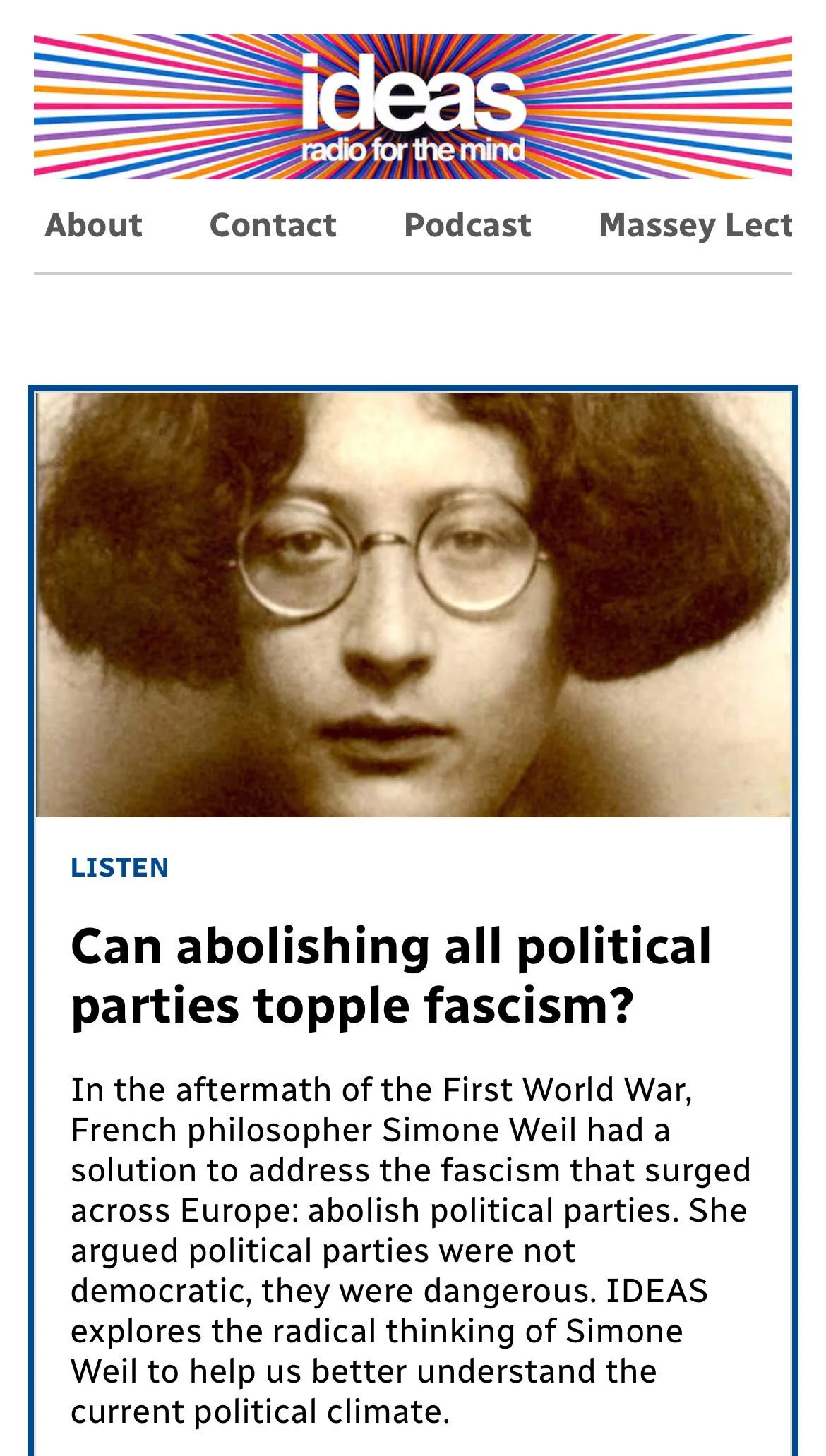
In the aftermath of the First World War, French philosopher Simone Weil had a solution to address the fascism that surged across Europe: abolish political parties. She argued political parties were not democratic, they were dangerous. With the help of Kathryn Lawson, Michael Ignatieff and Scott Ritner, IDEAS producer Nicola Luksic explores the radical thinking of Simone Weil to help us better understand the current political climate.

Article for the Institute of Art and Ideas
The attention economy isn’t just stealing our focus; it’s reshaping our reality. Drawing on Simone Weil, philosopher Kathryn Lawson argues that social media algorithms don’t just distract us but commit a deeper form of violence, reshaping our minds and stripping away genuine human connection. Each scroll surrenders our thinking to machines designed solely to keep us engaged, replacing what Weil saw as true attention—essential for ethics and truth—with a hollow substitute. Now, as a California jury holds Meta and Google liable for fuelling a young woman’s childhood addiction to their platforms, the solution isn't simply logging off, but relearning how to genuinely attend to others and reclaim our mental autonomy.
“Simone Weil, the attention economy, and the annihilation of autonomy”
The Life and Thought of Simone Weil.
"The Young Idealist” with Christopher Satoor is a podcast dedicated to Classical German Philosophy and Post-Kantian Thought.
In this Episode: Dr. Kathryn Lawson explains why Simone Weil's thought matters today; and helps navigate the viewer lucidly through her complex, politics, ethics, and philosophy. Our discussion leads to a detailed analysis of Weil's relationship with metaphysics, ethics, Plato and Marx. Dr. Lawson discloses the meaning behind important Weilian concepts like Decreation, Uprootedness, Compassion & Metaxy.
Interview.
"In response to the traumas of climate catastrophe, Lawson’s Ecological Ethics shows us that suffering and beauty can be integrated at the heart of environmental consciousness. Like Keller’s Face of the Deep and Leopold’s Sand County Almanac, this is a rare treasure that unites profound intellectual insight and ethical urgency."
Daniel O’Dea Bradley, Professor of Philosophy, Gonzaga University, USA

Interview.
Spotlights: Yale Forum on Religion and Ecology with Sam Mickey.
This episode of Spotlights features Kathryn Lawson, PhD, lecturer in philosophy at Carleton University in Ottawa, Canada. We discuss her new book, Ecological Ethics and the Philosophy of Simone Weil: Decreation for the Anthropocene, which was just released in the Environmental Ethics series at Routledge. We discuss her unique juxtaposition of the 20th-century French philosopher Simone Weil and the challenges that the Anthropocene poses for ecological ethics. Some of the topics covered include Weil's concepts of decreation, grace, attention, and ethical action, as well as Weil's reading of Plato as a non-dual thinker who affirms life and embodiment. This episode will surely be of interest to anyone concerned with the importance of spiritual practice for ecological ethics as well as anyone concerned with the way that the Western philosophical traditions bears upon contemporary ecological issues.
Article
“Ethics for the End Times” in Politics and Rights Review

Book Launch.
A conversation hosted by the American Weil Society with author Dr. Kathryn Lawson and featuring Dr. E. Jane Doering, Dr. Scott, Ritner, Dr. Benjamin Davis, and Dr. Mary E. Witlacil.
The panel poses questions and thoughts about Kate's book on Ecological Ethics and the philosophy of Simone Weil: Decreation for the Anthropocene.
.